

How Can a Hybrid VTOL Fixed-Wing Industrial Drone Improve Complex Aerial Operations?
2026-09-16
Industrial drone missions often require two seemingly different capabilities: precise vertical takeoff and landing in restricted spaces, and efficient forward flight for longer-distance operations. A Hybrid VTOL Fixed-Wing Industrial Drone combines these capabilities in one platform. By using vertical lift during takeoff and landing and fixed-wing aerodynamics during cruise flight, the aircraft can reduce dependence on runways while supporting efficient large-area missions. Research has highlighted the potential of hybrid VTOL systems for applications including surveying, inspection, agriculture, cargo transportation, and maritime operations.
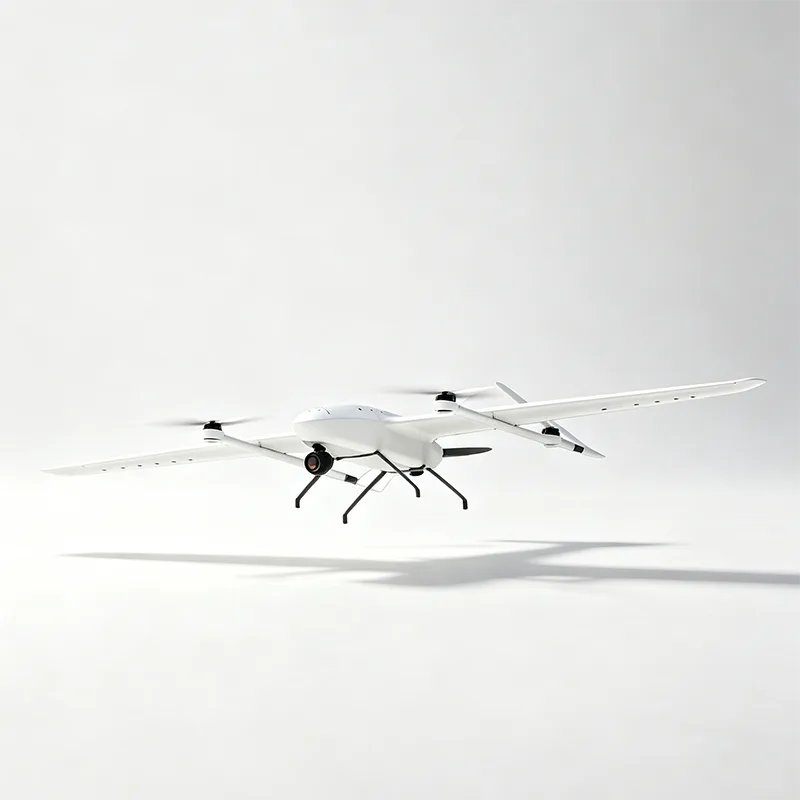
What Makes Hybrid VTOL Fixed-Wing Technology Different?
Traditional multirotor drones are highly maneuverable and can hover, but continuous hovering requires substantial energy. Conventional fixed-wing UAVs can achieve efficient forward flight but generally need suitable launch and recovery space.
A hybrid platform integrates both operating modes:
- VTOL mode: Vertical takeoff and landing from compact or unprepared areas.
- Transition mode: Controlled conversion from vertical lift to forward flight.
- Fixed-wing mode: Efficient cruising for extended-area coverage.
- Return mode: Conversion back to VTOL flight for controlled recovery.
This combination can be particularly valuable when a project involves large survey areas but has limited deployment infrastructure.
Why Is It Important for Industrial Applications?
For industrial users, drone value is not determined only by flight capability. The platform must also match the actual working environment, payload, mission duration, data requirements, and deployment conditions.
A Hybrid VTOL Fixed-Wing Industrial Drone can support applications such as:
| Application | Main Operational Value |
|---|---|
| Land surveying | Efficient coverage of large areas |
| Infrastructure inspection | Flexible deployment around complex structures |
| Pipeline inspection | Long-distance linear-route operations |
| Agricultural monitoring | Large-area aerial data collection |
| Mining | Mapping and site monitoring |
| Emergency response | Deployment without conventional runways |
| Maritime inspection | Operation from restricted deck areas |
| Environmental monitoring | Extended aerial observation |
The maritime application is particularly interesting. Research has demonstrated hybrid VTOL UAV operations from ship-based helipads, including autonomous takeoff and landing in moving maritime environments.
How Does It Improve Operational Efficiency?
The major advantage is the division of flight into appropriate operating modes.
During takeoff, the aircraft does not need a conventional runway. Once airborne, the fixed wings generate aerodynamic lift during forward flight, allowing the propulsion system to focus on cruise rather than continuously supporting the aircraft vertically.
This architecture can provide:
- Greater deployment flexibility
- Improved long-distance operating capability
- Efficient coverage of large areas
- Reduced dependence on launch infrastructure
- Flexible payload integration
- Better suitability for complex industrial environments
NOAA's work on shipboard VTOL-fixed-wing aircraft similarly emphasizes the combination of vertical launch/recovery with the range and endurance advantages associated with fixed-wing flight.
Hybrid VTOL vs. Traditional UAV Platforms
| Feature | Multirotor | Conventional Fixed-Wing | Hybrid VTOL Fixed-Wing |
|---|---|---|---|
| Vertical Takeoff | Yes | Usually No | Yes |
| Hovering | Excellent | No | Yes |
| Long-distance Flight | Limited | Excellent | Excellent |
| Runway Requirement | No | Usually required or alternative launcher | No |
| Large-area Coverage | Moderate | Excellent | Excellent |
| Confined-Space Deployment | Excellent | Limited | Excellent |
| Mission Flexibility | High | Moderate | High |
The hybrid configuration therefore addresses an important gap between rotorcraft flexibility and fixed-wing efficiency.
What Role Does Ship-Type Customization Play?
For marine, offshore, port, and vessel-related operations, a standardized drone may not always match the physical limitations of the deployment platform. Ship-type customization can therefore become an important product advantage.
Xuzhou Yihang Intelligent Technology Co., Ltd. can position its Hybrid VTOL Fixed-Wing Industrial Drone solutions around application-specific customization, including support for ship-type customization.
This means the UAV solution can be considered around factors such as:
- Ship deck dimensions
- Available takeoff and landing area
- Payload requirements
- Mission radius
- Maritime wind conditions
- Communication requirements
- Equipment mounting position
- Folding or modular structural requirements
- Mission-specific sensor configurations
- Recovery and storage arrangements
For offshore inspection or shipboard monitoring, these details can directly influence operational practicality. Experimental maritime UAV research has also identified turbulence and positioning around moving landing platforms as important engineering considerations.
How Can Customization Create More Practical Drone Solutions?
Industrial customers rarely have identical mission requirements. A surveying company may prioritize endurance and mapping payloads, while an offshore operator may prioritize compact storage, maritime adaptability, and shipboard takeoff and landing.
Customization can therefore cover multiple levels:
Airframe customization:
Wing configuration, structural dimensions, weight distribution, and modular design can be adapted to specific missions.
Payload customization:
Different cameras, mapping equipment, inspection sensors, or other mission payloads can be integrated according to operational requirements.
Control-system customization:
Flight-control parameters and navigation systems can be configured for different operating environments and mission profiles.
Ship-type customization:
For vessels with different deck layouts, storage limitations, or operational requirements, the aircraft structure and deployment solution can be designed around the vessel's characteristics.
This application-oriented approach allows the drone to become more than a standard UAV product—it becomes part of an integrated industrial aerial-operation solution.
What Results Can Industrial Users Expect?
When properly matched to the mission, hybrid VTOL technology can improve operational flexibility and reduce the infrastructure limitations associated with conventional fixed-wing UAV deployment.
Typical practical effects include:
- Faster deployment in remote locations
- Less dependence on runways
- Efficient coverage of extended routes
- Flexible operation in confined areas
- Greater adaptability to industrial payloads
- Improved suitability for shipboard operations
- More possibilities for mission-specific customization
However, actual flight time, payload, range, and endurance depend on the aircraft configuration, battery or propulsion system, environmental conditions, payload weight, and mission profile. Hybrid systems also involve additional propulsion and control components, so engineering optimization remains important.
Why Choose Xuzhou Yihang Intelligent Technology Co., Ltd.?
For industrial buyers, choosing a UAV manufacturer is not simply about purchasing an aircraft. It is about finding a solution that matches the intended operating environment.
Xuzhou Yihang Intelligent Technology Co., Ltd. can emphasize a solution-oriented approach centered on industrial UAV applications, including customized airframe configurations, mission-specific payload integration, and ship-type customization.
For customers operating from vessels, offshore facilities, remote industrial sites, or large inspection areas, customization can help align the UAV with actual operational conditions instead of forcing the mission to adapt to a generic aircraft.
Conclusion
A Hybrid VTOL Fixed-Wing Industrial Drone combines the deployment flexibility of VTOL aircraft with the efficient forward-flight characteristics of fixed-wing UAVs. This makes the configuration suitable for demanding applications such as surveying, inspection, infrastructure monitoring, environmental observation, and maritime operations.
For industrial customers, the next step is not simply asking which drone has the highest specifications. The more important question is whether the aircraft configuration fits the mission, payload, environment, and deployment platform. With ship-type customization as a key capability, Xuzhou Yihang Intelligent Technology Co., Ltd. can provide a more application-oriented direction for customers seeking customized industrial UAV solutions.
Looking for a Hybrid VTOL Fixed-Wing Industrial Drone tailored to your mission or vessel? Contact us to discuss your payload, operating environment, flight requirements, and ship-type customization needs, and explore a UAV solution designed around your application.